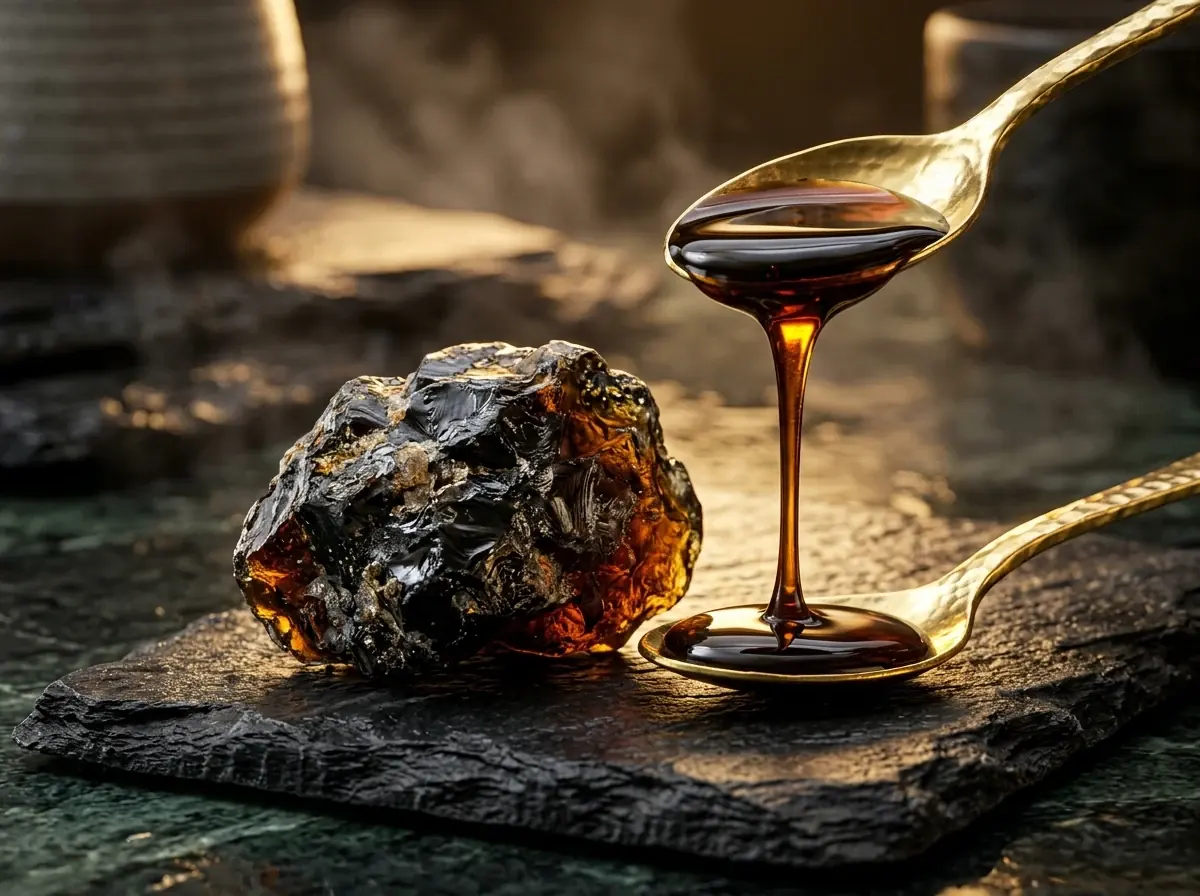
There is no home test that proves salajeet is genuine. What the traditional checks can do is catch the obvious fakes — and most of what is sold cheaply in Pakistan is an obvious fake. Here is what our hakeem looks for, and what only a laboratory can actually tell you.
Why so much of it is fake
Real salajeet seeps from rock in high mountains and has to be collected, washed and purified before it can be used. That work is slow and the yield is small. Demand in Pakistan is very large. The gap between the two is filled with imitation — usually a mixture of gum, molasses, soil, charcoal and cheap resin, pressed into a black block that looks convincing in a photograph.
This is not a small problem. If you are paying a low price for salajeet, you are almost certainly not buying salajeet.
What the traditional checks show
It should dissolve in warm water, not scatter
Stir a piece the size of a grain of rice into warm water. Purified salajeet dissolves into a dark golden-brown solution. It clouds the water evenly. What it should not do is break into floating specks, leave grit at the bottom, or leave an oily film on the surface. Sand and soil sink. Gum and molasses often leave the water sticky rather than coloured.
It should change with temperature
Genuine purified salajeet is firm when cold and becomes soft and tacky in the hand as it warms. Put it in the fridge and it hardens; hold it and it gives. A block that stays exactly the same at any temperature is usually bound with something that is not salajeet.
The smell should be mineral, not sweet
It smells of earth and stone, slightly bitter, a little smoky. It does not smell sweet. A sweet or caramel smell usually means molasses or jaggery in the mix.
The taste is bitter
Strongly bitter, with a mineral edge that stays. If it tastes pleasant, or sweet, something has been added.
The flame test tells you less than people claim
You will see videos where a piece is held to a flame and the seller says real salajeet does not catch fire. Treat this loosely. Purified salajeet tends to bubble and give off a burnt-earth smell rather than burning with a clean flame, but plenty of adulterants behave similarly, and a resin-heavy fake can be made to pass. It is a weak signal on its own.
What none of these checks can tell you
This is the part most sellers leave out.
Salajeet is a mineral substance drawn out of rock. The serious risk with a poorly sourced or badly purified batch is heavy metal content — lead, arsenic, mercury — which is invisible, has no smell and no taste, and which no kitchen test will ever reveal. Raw, unpurified salajeet is not safe to take, and this is exactly why the classical texts describe a purification process rather than treating the raw material as the medicine.
The only way to know is a laboratory heavy-metal test on the batch you are holding. Nothing you can do at home substitutes for it.
What to ask a seller
- Where was it collected, and in what form did you receive it?
- Was it purified, and by what method?
- Do you have a heavy-metal test for this batch? Can I see it?
- What is the batch number and the expiry date on my jar?
A seller who cannot answer the first two has not handled the material. A seller who becomes vague at the third is the one to walk away from.
Where we stand on this
Our Majoon Zafran & Salajeet is prepared in our own dispensary from purified salajeet, and the ingredient list on the product page names every component with its botanical name. We are honest about what we do not yet have: we do not currently publish a third-party heavy-metal report. When we have one, it will go on the product page where you can read it, not in a claim.
Until then, judge us the way we are telling you to judge everybody else — on what we will show you, not on what we say.