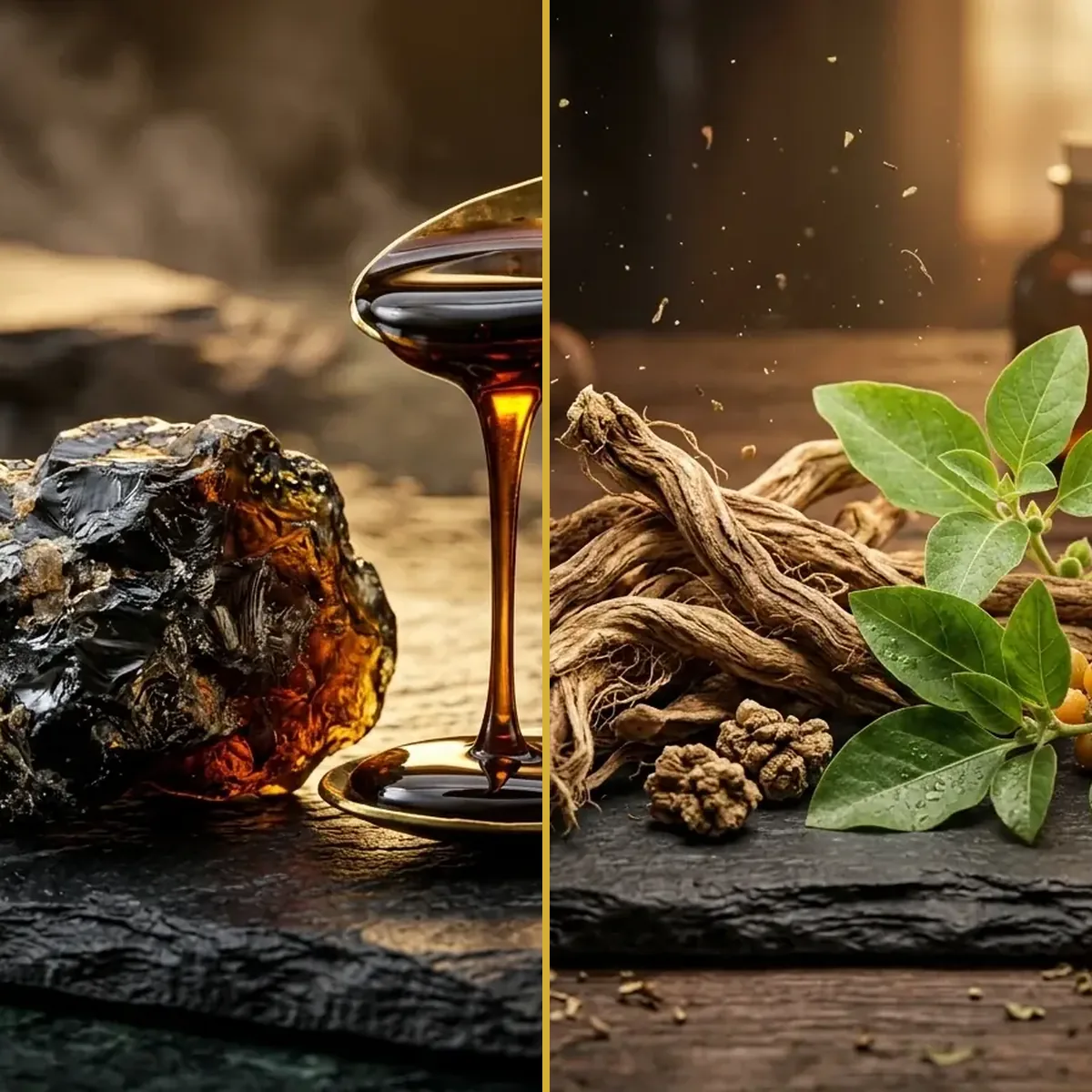
Salajeet and asgandh are not alternatives to each other. They are used for different things in Unani practice, they behave differently in the body, and a formulation often contains both. If you are trying to pick one, the more useful question is what you are actually looking for.
The short version
- Salajeet (سلاجیت, Asphaltum punjabianum) is a mineral substance, not a plant. In Unani practice it is used as a strengthening tonic — for physical stamina and recovery from weakness.
- Asgandh (اسگندھ, Withania somnifera) is a root. It is used where the complaint is nervous strain, poor sleep and tiredness rather than physical depletion.
They are different kinds of thing
This sounds obvious but it is where most of the confusion starts. Salajeet is scraped from rock and purified. Asgandh is a plant root, dried and powdered. They are prepared differently, they are dosed differently, and the traditional reasoning behind each is different.
People treat them as competing products because both are marketed in Pakistan under the same vague heading. In a hakeem's practice they are not competing at all.
How each is traditionally used
Salajeet
Classical Unani use is as a muqawwi — a strengthening agent. It is given where there is physical weakness, poor stamina, slow recovery after illness or exertion. It is taken in very small quantities, usually with milk, and over a course of weeks rather than as a single dose.
It is warming in Unani terms, which is part of why it is traditionally taken in cooler months and with milk rather than on its own.
Asgandh
Asgandh is used where the picture is nervous rather than physical — someone who is tired but wired, sleeping badly, under strain. It is also a muqawwi, but of the nerves rather than the body.
It is usually given as a powder with warm milk at night, again over weeks.
Why formulations contain both
Because the two complaints usually arrive together. Someone who is physically depleted is rarely sleeping well either. Classical Majoon formulas pair a mineral tonic with plant tonics for exactly this reason — the combination is the formulation, not a way of padding the ingredient list.
Our Majoon Zafran & Salajeet contains purified salajeet, asgandh nagori, zafran and khar-e-khasak together, in the proportions of the traditional formula.
If you are choosing between them
Ask what the actual complaint is.
- Physical weakness, poor stamina, slow recovery — salajeet is the traditional answer.
- Tiredness with nervous strain and poor sleep — asgandh is.
- Both together, which is the common case — a formulation containing both makes more sense than either alone.
What neither of them is
Neither is a medicine, and neither works overnight. Both are traditional preparations taken over a course of weeks. If a seller tells you either one produces an immediate result, they are describing something other than how these materials are used.
If you take prescribed medicine, or have diabetes, blood pressure, heart, liver or kidney trouble, speak to your doctor before starting either. Asgandh in particular is worth mentioning to your doctor if you are on medication for thyroid or blood pressure.
Buying either one in Pakistan
Adulteration is the real issue with salajeet, and we have written separately about how to tell real salajeet from fake. With asgandh the more common problem is simply old stock — powdered root loses its character on a shelf, and the cheap bags sold loose in bazaars are frequently years old.
In both cases, ask when it was prepared, and buy from somebody who can tell you.